Stigma surrounding older women dating younger men
Bridget Jones: Mad About the BoyThe stigma surrounding older women dating younger men in Bridget Jones’s story arises from a culture that treats women’s age as a measure of sexual value while granting men greater freedom to begin again. Its force comes not only from explicit disapproval, but from the pressure to look younger, the assumption that a younger partner must be a temporary mistake, and the ready-made story that an older woman is exploiting him. Bridget Jones’s relationship with Roxster makes those judgments personal: what begins as an affectionate connection becomes shadowed by a difference neither of them can simply wish away.
Age, widowhood, and unequal expectations
The surrounding talk makes age-gap stigma part of a broader double standard. After Bridget Jones has been widowed, Cosmo insists that enough time has passed and that she cannot wear widow’s weeds forever. Woney tries to defend the difficulty facing middle-aged women who find themselves single, but the discussion quickly turns to Binko Carruthers, whose prospects improved after his wife left him. Cosmo imagines a man gaining a new lease on life and pursuing someone younger. The comparison treats men’s renewed romantic freedom as ordinary while making women’s age and singleness a problem to explain.
Bridget Jones’s narration is alert to the language that carries this judgment. She resents both middle-aged and Of a Certain Age as labels applied to women with condescending implications. Woney’s appearance becomes an uncomfortable counterpoint to Talitha’s insistence on deliberate rebranding: Woney has let her hair go grey and cut it short, and does not rely on the facials, peels, or makeup that Talitha recommends. Bridget Jones considers several possible reasons, including honesty, confidence, and feeling loved for who she is. That reflection complicates any easy claim that every woman must want to look younger. The social pressure is real, but Woney’s choices also suggest that refusing to make appearance or sexuality the measure of the self can itself be a form of independence.
The book also sketches a gendered chronology of romantic power. In Bridget Jones’s account, women in their twenties have an advantage because they are widely desired, while men in their thirties gain ground as their careers develop and women face pressure from a biologically unfair clock. This is presented as Bridget Jones’s interpretation of social patterns, not as a neutral rule. Its significance lies in how it makes age seem to determine bargaining power before any two particular people have met. The imagined clock and the language of advantage turn dating into a contest structured by unequal expectations.
The demand to rebrand
Talitha gives those expectations a practical, consumer-facing vocabulary. She argues that looking younger depends on altering the body’s signposts: resisting the fat-positioning of middle age, avoiding wrinkles, and having shiny, healthy hair, however obtained. Her advice frames ageing as something to manage through appearance. Bridget Jones’s concern about being used to rebrand herself through Roxster therefore has a history within the story: she has already encountered a social script in which the older woman is expected to correct the visible evidence of time before she can feel sexually confident.
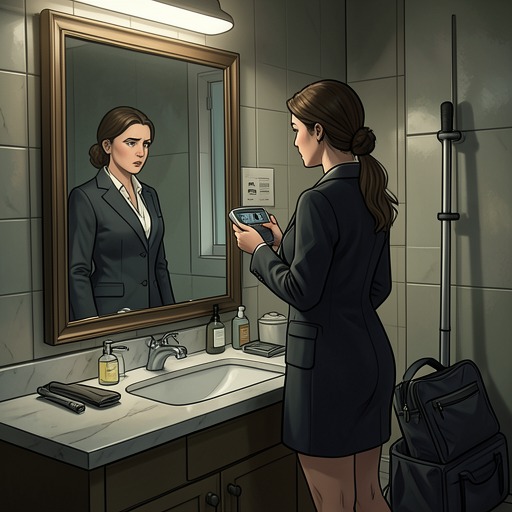
The pressure reaches beyond romantic encounters into daily media consumption. While she is supposed to be writing, Bridget Jones reads a story judging Jessica Biel for a pantsuit supposedly lacking sex appeal, then buys Grazia and concludes that her own style is outdated. She thinks she must wear skinny jeans, ballet pumps, a buttoned-up shirt, a blazer, a large handbag, and sunglasses for the school run. The episode shows how quickly a passing fashion judgment becomes a personal demand to look current and desirable. Daniel Cleaver’s arrival with gifts and a remark about her having been on a diet reinforces the sense that people respond differently when she is thinner or dressed up. Taken together, these moments show that the stigma does not begin only when a younger partner appears; it is sustained by routine judgments about women’s bodies and presentation.
Bridget Jones’s decision to get Botox makes that pressure concrete. On 18 June, she records her weight as 136 pounds, including a pound of botulism, and recalls Talitha comparing the treatment to a visit to the dentist. Yet she descends into a basement off Harley Street feeling as though she were going to an illicit practitioner and worries that she might look strange. The comic contrast between casual reassurance and apprehension captures the ambivalence of rebranding: the procedure is presented as ordinary maintenance, but the anxiety behind it exposes how much is at stake in trying to alter the signs of age.
The cougar story and its counter-story
A newspaper article titled The Tragic Fate of the Toy Boy turns the age-gap relationship into a sensational social type. By Ellen Boschup, it claims that more older women are pursuing younger men, whom it labels cougars’ prey. Its older women are portrayed as preserved, predatory, and attracted to younger men for energetic sex and companionship without family or career demands. The younger men, in turn, are cast as vulnerable victims who may be left sexually exhausted, diminished, and stranded after their usefulness has passed. The article offers a complete plot in advance: the older woman takes advantage, and the younger man eventually suffers.
Bridget Jones is shaken by what she reads, especially because the article gives public authority to a story that could be applied to her own relationship. Her anger is directed at the casual manufacture of social generalizations: she objects to claims presented as the conclusion of deep research when they may rest on overheard conversations and a few photographs. The article matters not because the story it tells is established as fact, but because such language can make a private relationship appear guilty before its participants have defined it. The novel sets this sensational account against the actual uncertainty and affection between Bridget Jones and Roxster.
Roxster and the age difference
At a party, Roxster appears in one of the Silver Fox’s immaculate outfits. Talitha calls his presence rebranding, and Bridget Jones admits that she worries about using him that way, though she says it happened without deliberate intention. Her worry is complicated by the fact that she is falling for him. The scene holds two explanations in tension: Roxster could be treated as evidence of youthfulness, but he is also a person with whom she feels a genuine connection. The difference between those meanings cannot be settled by a fashionable outfit or by Talitha’s label.
The age gap first becomes explicit for Roxster after a night of exuberant partying. The next morning, Bridget Jones remembers his happiness and affection, but also the sadness that surfaced when he said he wished he had a time machine. He had joked before about her knees and teeth, yet this was the first time he had directly mentioned their age difference. Bridget Jones understands that the relationship is not merely a brief encounter: they have found someone they like amid the disorder of online dating, and the connection feels affectionate and fun. His remark reveals that the age gap matters to him, bringing an unspoken concern into view without cancelling the closeness they share.
Talitha’s response to the couple’s planned mini-break shows how quickly that concern becomes a forecast. She warns that once Roxster has begun to wobble, he is thinking about the long term, and that he is too young to know what a disastrous mistake that might be. Bridget Jones tries to shut out this interpretation and concentrate on the trip. The advice is protective in tone but also repeats the assumption that a younger man will eventually regard the relationship as a mistake. In this way, stigma works partly through anticipation: other people supply an unhappy ending before the couple has reached one.
Significance
The story does not reduce the issue to whether an age-gap relationship is acceptable or doomed. Instead, it traces the ways a woman’s age is made socially legible through her appearance, her romantic prospects, and other people’s descriptions of her motives. The newspaper’s predatory cougar and Talitha’s carefully rebranded woman are opposing images, but both risk turning older women into types. Against them, Bridget Jones’s account insists on the awkward particulars: Roxster’s affectionate happiness, his moment of sadness, her mixed feelings about being seen with him, and the long-term question neither glamour nor denial can remove. The stigma is powerful because it offers ready-made explanations for their relationship; its limits become visible when those explanations are measured against the people actually living it.